
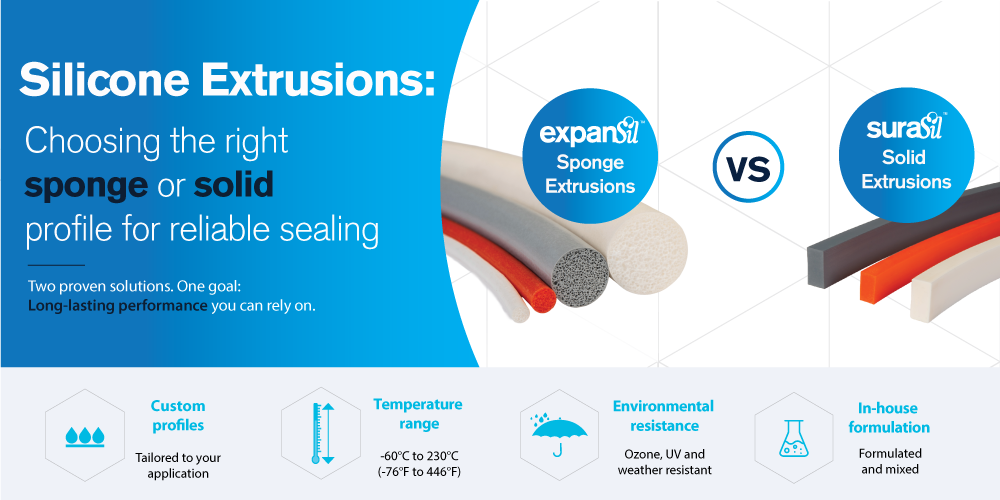
Silicone extrusions solve a very practical engineering problem: they turn a proven silicone compound into a repeatable profile that can seal, cushion, insulate or protect a component without making installation harder than it needs to be.
Across transport, industrial equipment, energy systems and enclosure design, that combination is why engineers keep returning to silicone when they need a seal that can handle weather, heat, vibration and long service life.
What are silicone extrusions and where are they used?
Understanding extruded silicone profiles
Silicone extrusions provide a versatile sealing solution for a wide range of industrial applications. Manufactured in both sponge and solid silicone grades, they are available in numerous profile shapes and formats, allowing engineers to specify a solution tailored to their sealing, insulation or protection requirements.
Our expanSil™ sponge range and suraSil™ solid rubber extrusions ranges are manufactured in continuous lengths, providing engineers and buyers with a flexible sealing solution that can be cut, fabricated or joined to suit their application. Available in a wide range material grades, both ranges are designed to support everything from standard sealing requirements to complex custom designs.
Common uses across industrial, transport and enclosure applications
Silicone extrusions are used in seals, gaskets, thermal barriers and protective trims, for sponge extrusions, this often includes enclosure seals, outdoor lighting gaskets, HVAC seals, door seals and outdoor digital signage. The solid range, however, is more used across industries including energy, transport, food and beverage, HVAC and rail.
Sponge vs solid: the key silicone extrusion choice
How silicone sponge extrusions perform in sealing applications
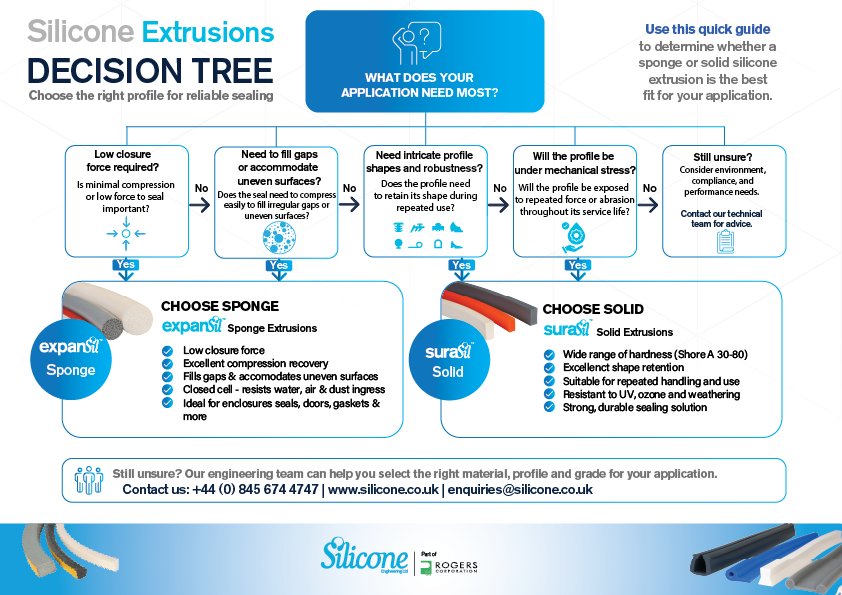
Sponge extrusion is a fantastic solution when the design challenge is to close gaps, absorb tolerance variation, damp movement or create a seal with lower closing force.
Our expanSil™ sponge range, as a closed-cell material, has excellent ozone and UV resistance, thermal stability from -60°C to 230°C, low water absorption and strong compression force deflection. This is why our sponge profiles are so often used where dust, water and air ingress have to be controlled without overloading a closing mechanism.
On the London Underground enclosure door seal project, our engineers specified a flame-resistant, low-smoke sponge profile to help the enclosure protect critical electronics in a humid, vibration-prone environment, while still delivering a low-compression seal against dust and water ingress.
On the EV charging station project, the team tested different sponge densities before choosing the option that delivered the best sealing performance and the required IP67 result.
When to specify solid silicone extrusions instead
Solid extrusion is the better choice when the profile needs more body, more tear resistance, a more defined section or a seal that must hold its shape under repeated use.
Our suraSil™ solid range is available in shore A hardness from 30 to 80, with general-purpose grades that comply with FDA, WRAS and EC1935/2004, plus specialist grades for high tear, flame retardant, high temperature, low smoke and toughness requirements. That makes solid silicone a strong fit for applications such as marine edge trims, freezer door seals, food-contact components and other demanding profiles where dimensional stability matters as much as sealing.
In the luxury yacht sliding roof case study, the solid profile had to maintain sealing performance in extreme conditions at sea, with silicone’s UV resistance and temperature range being a core reason for the material choice.
On the aircraft refrigerator-freezer seal project, the solid profile was selected for a sub-zero application where flame retardancy and controlled temperature performance were both important. Those are typical solid-extrusion conversations: if the profile is doing more than simply closing a gap, solid often becomes the safer technical choice.
Profiles, sizes and formats engineers rely on
Cords, tubes and standard section profiles
The practical appeal of silicone extrusions is that they’re not limited to one profile family. At Silicone Engineering, we manufacture both sponge and solid products in cord, tube, profiles and sections, giving design teams a straightforward route from concept to a workable sealing geometry – this is especially important when they need to match an existing channel, frame or enclosure detail.
Custom extrusion shapes for project specific requirements
When a standard geometry isn’t suitable for your project, we can tailor profiles to exact designs. This means we can create the profile around the problem, rather than you trying to force the problem to fit a stock part.
Matching silicone extrusions to real world design challenges
Sealing outdoor and IP rated enclosures
Outdoor enclosures can fail in a few predictable ways: water gets in, dust gets in, seals lose compression over time, or the changes in temperature create condensation. But silicone is well suited to outdoor environments because it keeps its flexibility across a wide temperature range and resists UV and ozone exposure.
Our offshore enclosure case study shows expanSil™ GP350 helping meet IP66/67 performance, while the EV charging station case study (above) shows a sponge extrusion being tuned to achieve IP67 water resistance.
Managing vibration, shock and tolerance stack ups
Not every seal is there to keep the weather out – in transport and industrial equipment, the profile may also need to absorb vibration, handle repeated movement and compensate for tolerance stack-up without losing its sealing force.
Vibration damping is a key benefit of silicone extrusions, and the London Underground case study (above) shows a low-smoke, flame-resistant sponge profile being chosen because it had to perform in high humidity, vibration and temperature extremes. In that kind of design, a sponge profile often gives the best balance between compliance and closing force.
Handling high temperatures and demanding environments
High-temperature sealing isn’t just about surviving heat; it’s about retaining the performance margin after repeated thermal cycling. Silicone Engineering’s expanSil™ range includes a THT grade rated for +270°C, while suraSil™ includes high-temperature and flame-retardant grades for more demanding solid-profile applications.
This is why silicone extrusions are commonly used in energy, aerospace, food, marine and other environments where heat, pressure or fire safety can define the material decision.
Materials, grades and compliance considerations
Density, durometer and compression behaviour
The choice between sponge and solid is often really a choice about compression behaviour. Sponge profiles are available from soft to firm densities, giving designers a way to match closing force to the gap they need to seal, while solid profiles are available in shore A hardness from 30 to 80 for applications that need more body and more controlled resilience.
In both cases, the right material is the one that creates a reliable seal without overloading the assembly, distorting the housing or making service work difficult.
Specialist grades, approvals and industry requirements
Where compliance is critical, Silicone Engineering offers a broad set of specialist options. On the sponge side, expanSil™ includes V-0 grades compliant with EN45545-2, NFPA-130 and UL94V0, plus FDA, LCH and THT options. On the solid side, suraSil™ includes FDA, WRAS and EC1935/2004 compliant GP materials, along with FR, THT, LCH, HT and TS variants.
We also have 3-A Sanitary 18-03 class 1 approval for suraSil™GP 40, 60 and 70 shore, which is especially relevant where hygienic performance is part of the specification.
Using Silicone Engineering’s extrusion capabilities
What’s inside the Silicone Extrusion Capabilities Guide (PDF)
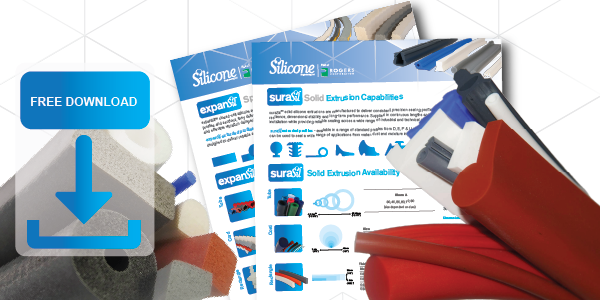
The Silicone Extrusion Capabilities Guide (PDF) should be the first technical checkpoint for engineers specifying extruded silicone seals. It connects real manufacturing capability to practical design choices, showing what profile types are available, what dimensions can be produced, and which grades are suited to requirements such as flame retardancy, low smoke and toxicity, high temperature performance or food contact compliance. It brings our expanSil™ closed-cell sponge and suraSil™ solid extrusion ranges into one clear reference, covering the most commonly specified formats including cord, tubing, standard section profiles, strips and custom shapes.
Complete the form below to claim your Silicone Extrusion Capabilities Guide and explore our range of sponge and solid extrusion profiles.
Next steps: discussing your use-case with Silicone Engineering
The strongest extrusion solution usually comes from the problem being described clearly at the start. We work closely with customers from enquiry and design through to formulation, manufacturing, testing and, where needed, site visits. For design engineers and technical buyers, that makes the next step straightforward: share the sealing challenge, the operating environment, the compliance target and the installation constraints, and let us help specify whether a sponge or solid profile is the better fit.
Silicone Engineering has been focused on silicone processing since 1959, and our extrusion ranges are built around that long-running specialist knowledge. Get in touch today to discuss your next project.