
Reducing carbon emissions across the supply chain is a priority for lots of organisations that are working towards Net Zero targets. While much of the focus is on energy consumption, transport and manufacturing processes, material selection also has a significant influence on lifecycle emissions.
Choosing components that last longer, require less maintenance and reduce waste can have a greater impact on lifecycle carbon emissions than buying materials based solely on their purchase cost.
For many sealing, insulation and gasketing applications, silicone elastomers offer clear lifecycle advantages over traditional elastomers such as EPDM, nitrile rubber (NBR) and natural rubber, making them an increasingly valuable choice for engineers trying to decarbonise their supply chains. We’ll delve into these benefits further down this article.
Decarbonising supply chains and material choice
Regulatory requirements, customer expectations and corporate sustainability commitments are driving businesses to examine not only their own operations, but also the carbon footprint of the products and materials they specify.
For engineers, this means considering a product or material’s whole-life performance rather than focusing solely on purchase price. A component that performs reliably for significantly longer can reduce maintenance interventions, minimise downtime and reduce the embodied carbon associated with manufacturing, transportation and replacement.
This lifecycle focus is changing how elastomer materials are evaluated across industrial, energy and transport sectors.
Silicone vs traditional elastomers: what are we comparing?
Elastomers are elastic polymers used extensively in seals, gaskets, insulation products, hoses and vibration control components. Traditional elastomers include materials such as EPDM, NBR, neoprene and natural rubber.
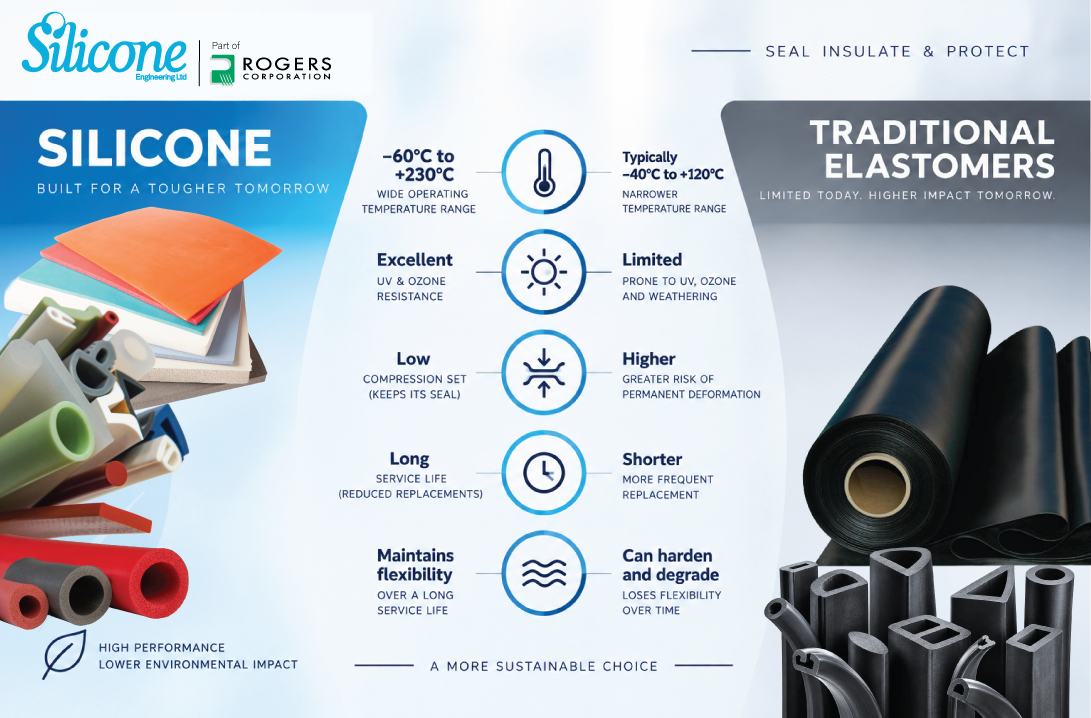
Silicone elastomers differ because their molecular structure provides exceptional stability across a much wider operating range. Silicone typically offers:
- Excellent performance across extreme high and low temperatures (-60°C to 230°C)
- Superior environmental resistance, such as UV exposure, ozone resistance and weathering
- Outstanding longevity
- Low compression set for long-term sealing performance
- Reliable flexibility throughout extended service life
These characteristics allow silicone components to perform well in demanding environments where more traditional rubber elastomers can gradually harden, crack or lose elasticity.
Lifecycle performance: why service life matters more than unit cost
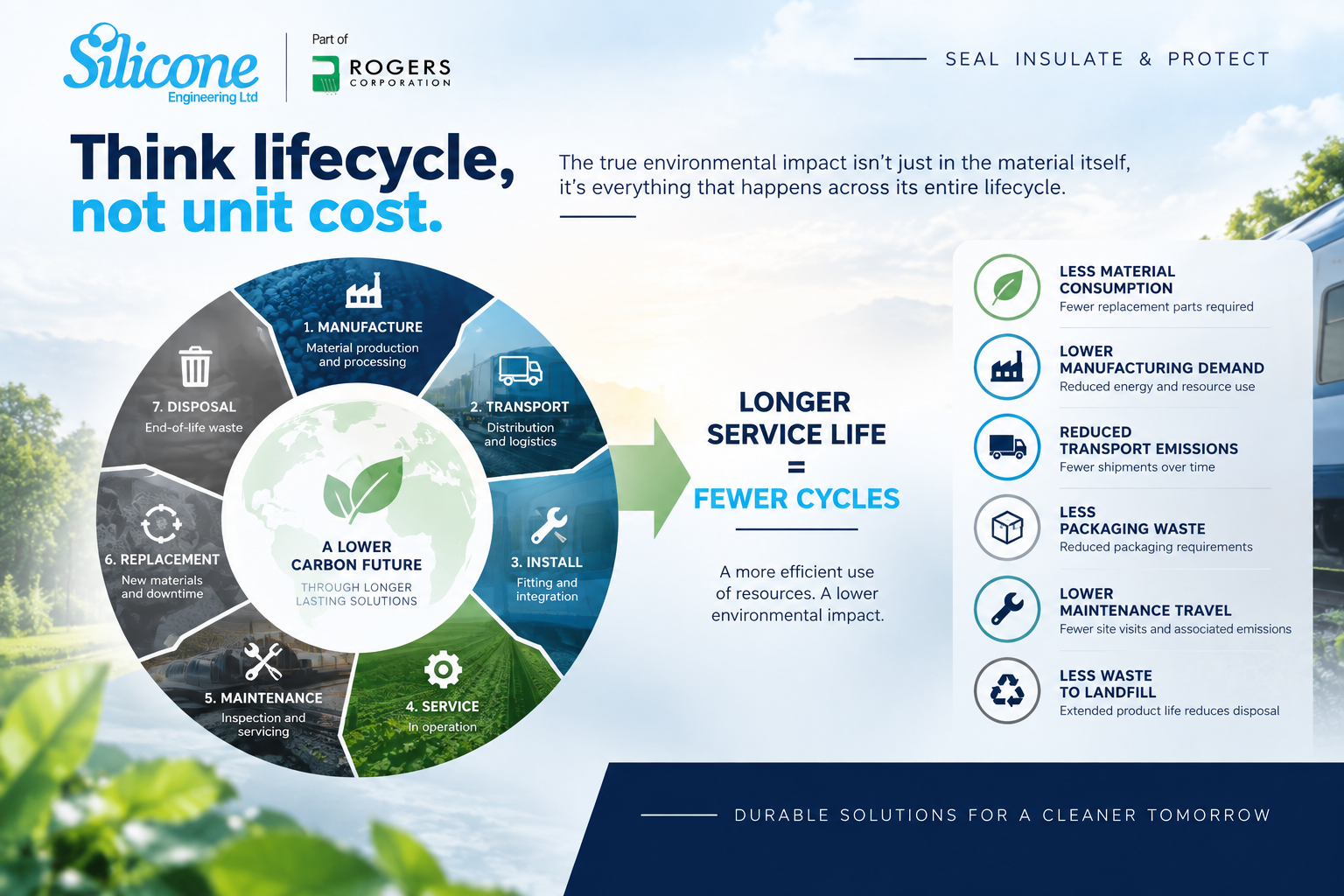
Selecting an elastomer solely on its initial purchase cost can result in higher overall ownership costs if the components require frequent replacements. A lifecycle approach considers the total environmental and operational impact over the product’s working life, including:
- Manufacturing emissions
- Transportation
- Installation
- Maintenance visits
- Downtime
- End-of-life disposal
- Replacement components
As silicone components stay in service for much longer than traditional elastomers, the impacts of the above are spread over a much longer operational life.
Fewer replacements also mean fewer manufactured parts, reduced logistics activity and less waste generation. In many industrial environments, avoiding a single maintenance shutdown or engineer call-out can provide greater environmental and commercial value than the small difference in initial material cost.
For those organisations that are measuring their Scope 3 emissions, extending component life can have a significant impact on the supply chain, directly lowering embodied carbon per year of service.
Compression cycles and seal integrity over time
One of the most important measures of elastomer performance is compression set – the ability of a material to return to its original shape after prolonged compression.
Seals that develop a high compression set gradually lose contact pressure, increasing the risk of leakage, contamination or reduced thermal efficiency. This often leads to premature maintenance or component replacement.
Silicone elastomers are recognised for maintaining a low compression set across extended service periods, even when they’re exposed to elevated temperatures and repeated compression cycles. This enables seals and gaskets to keep their effectiveness for longer than many conventional elastomer alternatives.
Maintaining seal integrity delivers several sustainability benefits:
- Reduced leakage of air, fluids or process media
- Improved equipment efficiency
- Lower maintenance frequency
- Fewer replacement components
- Reduced process disruption
Across industrial systems, these incremental improvements can contribute to significant reductions in energy use, operational waste and carbon emissions.
Reduced replacement intervals = less waste and lower emissions
Every replacement component carries an environmental cost. Raw material extraction, manufacturing, packaging, transportation, installation and disposal all contribute to an elastomer’s overall carbon footprint.
By extending the time between replacements, silicone elastomers help reduce:
- Material consumption
- Manufacturing demand
- Packaging waste
- Transport emissions
- Maintenance travel
- Disposal of worn components
The Global Silicones Council’s lifecycle assessments have demonstrated that silicone-enabled applications can create greenhouse gas savings that significantly outweigh the emissions associated with manufacturing and end-of-life processing. In many applications, the operational efficiency and longevity delivered by silicone produce net environmental benefits many times greater than the material’s production impact.
This means that specifying longer-lasting elastomer components is a practical and measurable sustainability strategy for organisations who are developing lower-carbon products or reducing operational emissions.
Application examples where silicone enables decarbonisation
E-mobility
Electric vehicle battery systems require reliable sealing, thermal management and electrical insulation under demanding operating conditions. Silicone’s durability and temperature stability help extend component life while supporting battery efficiency and reducing maintenance requirements.
Renewable energy
Wind turbines, solar installations and energy storage systems are expected to operate reliably for decades in challenging outdoor environments. Silicone elastomers withstand UV exposure, moisture and temperature extremes, reducing replacement frequency and improving longevity.
HVAC and building envelopes
Heating, ventilation and air conditioning systems depend on effective sealing to maintain energy efficiency. Long-lasting silicone gaskets help minimise air leakage, supporting lower energy consumption and reducing maintenance across commercial buildings.
Food and pharmaceutical processing
Equipment operating in hygienic environments requires sealing materials that maintain performance despite frequent cleaning, temperature fluctuations and demanding operating conditions. Silicone’s long service life reduces production interruptions while lowering waste generated through routine seal replacement.
Rail and mass transport
Public transport infrastructure demands components that can withstand vibration, weather exposure and long service intervals. Silicone elastomers support dependable performance while reducing maintenance interventions that contribute to operational emissions and network disruption.
How Silicone Engineering supports low-carbon design
At Silicone Engineering, we work with you to understand the operating environment, mechanical demands and lifecycle expectations of the project before recommending the most suitable silicone solution. By combining extensive materials expertise with advanced manufacturing capability, we help engineers specify components that optimise performance, durability and sustainability outcomes.
Early material selection can improve reliability while contributing to broader decarbonisation goals throughout the supply chain. Compared with many traditional elastomers, silicone offers longer service life, excellent environmental resistance and superior compression set performance. These characteristics reduce maintenance requirements, minimise waste, extend replacement intervals and lower the lifecycle emissions associated with elastomer components.
If you’re reviewing your elastomer applications for sustainability or performance, Silicone Engineering can help. Speak to the technical team to discover where silicone solutions could improve lifecycle performance while supporting your wider decarbonisation objectives.